
There is a distinct, quiet responsibility that comes with being the sole waking soul on a dark, rain-slicked country road. In Night Bus to Orford, a masterful driving simulation that turns routine public transport into an exercise in narrative observation, you are simply ensuring that a handful of weary passengers make it home safely through the storm. It is a game where the road itself becomes the conversation, and every puddle, flooded bend, and hesitant passenger interaction speaks volumes about the human condition.
The Solitude of the Night Shift
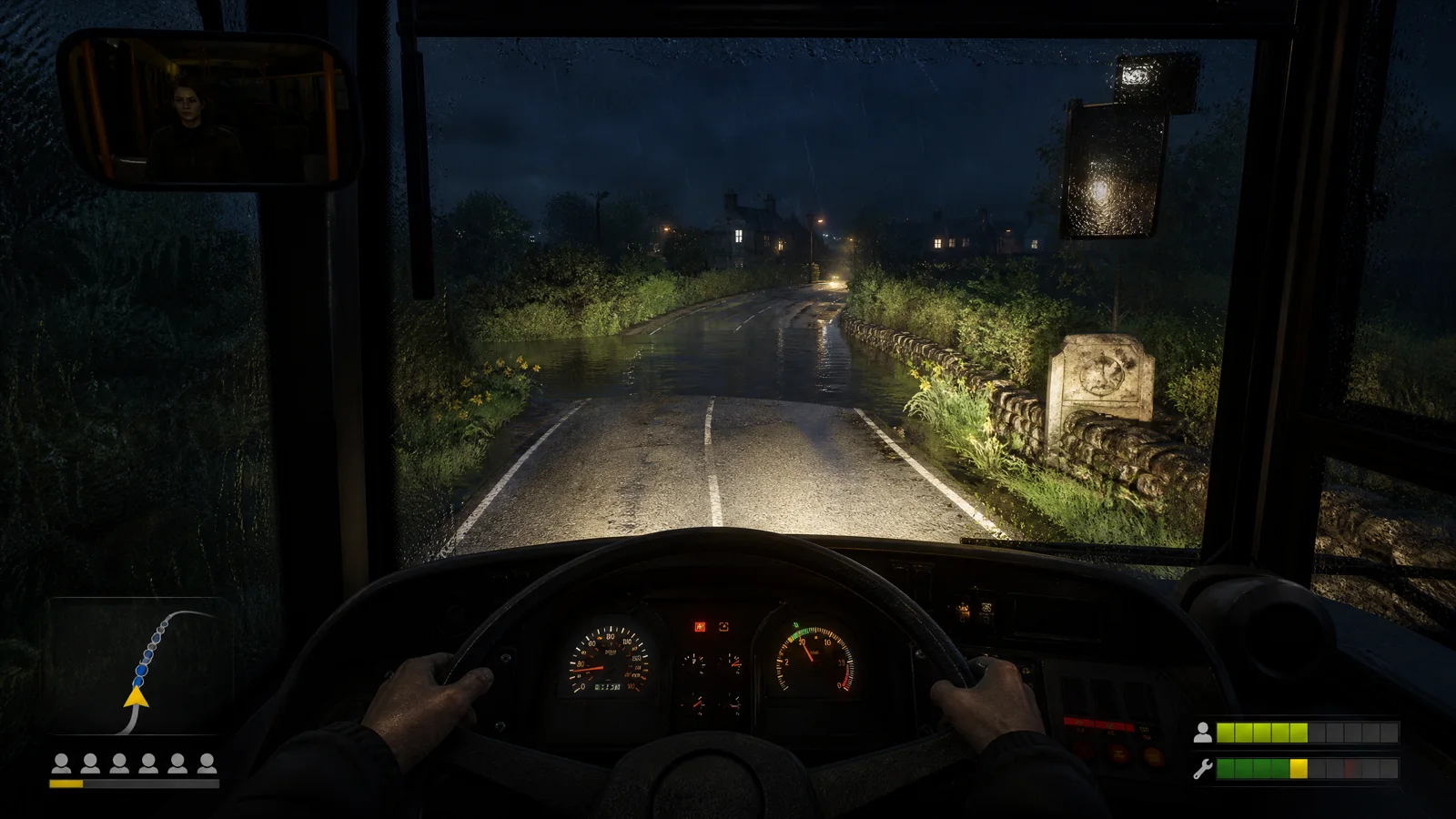
The first-person perspective immediately grounds you in the driver’s seat, a vantage point that feels simultaneously powerful and isolated. As you pull out of the depot, the rhythmic sweeping of the windscreen wipers becomes your primary companion. The visual feedback is exceptional. The dashboard glows with a warm, utilitarian amber, illuminating the complex array of dials, switches, and gauges that demand your constant attention. Beyond the glass, the rural British landscape is swallowed by an oppressive night, pierced only by the sharp cones of your headlights reflecting off the wet tarmac.
It is in these quiet moments that the game establishes its tone. You catch glimpses of your passengers in the rearview mirror—a lone commuter staring blankly into the darkness, a couple huddled together against the chill. The reflection in the glass is a subtle but powerful reminder of the cargo you carry. The audio design further reinforces this atmosphere, with the heavy drumming of rain against the roof and the resonant hum of the diesel engine providing a constant baseline. The world outside is hostile, but inside this rolling metal box, there is a fragile sanctuary that you must maintain.
Weight, Momentum, and Passenger Comfort
Night Bus to Orford is uncompromising in its approach to vehicle handling. This is a meticulous study of weight, momentum, and spatial awareness. The bus feels heavy, ponderous, and entirely beholden to the laws of physics. Accelerating requires patience, and braking demands foresight. Every corner must be approached with caution, factoring in the length of the chassis and the slickness of the rain-soaked roads. The steering is deliberate, requiring smooth, measured inputs to avoid jarring the occupants.
Crucially, the mechanics of driving are inextricably linked to passenger comfort. The game tracks your performance through the subtle reactions of those seated behind you. Brake too sharply, and you will hear a collective gasp or the unsettling thud of a dropped bag. Take a corner too aggressively, and the murmurs of discontent will grow louder. You are constantly balancing the demands of the timetable with the need for a smooth ride. This dynamic is reinforced by the necessity of constant mirror checks. Monitoring the interior mirror ensures your passengers are settled, while the exterior mirrors are vital for navigating narrow country lanes.
- Vehicle Handling: Realistic physics that demand anticipation and smooth, deliberate inputs.
- Mirror Checks: Essential for both spatial awareness and monitoring passenger well-being.
- Passenger Comfort: A hidden metric that dictates the atmosphere and subtle narrative shifts.
- Timetable Choices: Balancing punctuality with safety and ride quality in adverse conditions.
Navigating the Flooded Bends
The route to Orford is rarely straightforward. The dynamic weather system fundamentally alters the landscape and the challenges you face. A sudden downpour can quickly turn a familiar stretch of road into a treacherous obstacle course. The game frequently forces you to confront flooded bends, where deep water obscures the tarmac and threatens to stall the engine if approached too quickly. These moments require careful judgement, forcing you to slow to a crawl, assessing the depth and plotting a safe trajectory through the hazard.
When the main roads become impassable, route diversions come into play. The game does not hold your hand during these detours. You must rely on your knowledge of the local geography and the sparse rural signage to find an alternative path. These diversions are tense affairs, forcing your massive vehicle down single-track lanes flanked by imposing stone walls and overgrown foliage. The pressure of the timetable looms large, presenting a constant temptation to push the bus faster than is safe. It is a brilliant test of nerve and spatial reasoning.
Narrative Through Observation
What elevates Night Bus to Orford to a compelling narrative experience is its approach to storytelling. There are no grand cutscenes or exposition dumps. Instead, the narrative unfolds through quiet dialogue and environmental observation. As the journey progresses, passengers will occasionally strike up conversations with you or with each other. These interactions are brief, often mundane, but deeply evocative. A tired nurse discussing her shift, a teenager arguing quietly on the phone, an elderly man reminiscing about the changing landscape—these fragments of dialogue paint a rich tapestry of rural life.
Your role in these conversations is largely passive, but your driving influences the tone. A smooth, reassuring journey encourages passengers to open up, while a rough, erratic ride results in stony silence and terse exchanges. The game asks you to listen, to observe, and to piece together the stories of the people you transport. It is a profound exploration of the fleeting relationships that define public transport, turning the act of driving into an exercise in empathy.
The Potholes in the Road
For all its atmospheric brilliance, the journey is not entirely without its bumps. The visual fidelity of the bus interior and the immediate surroundings is stunning, but the illusion occasionally falters when peering too far into the distance, where the texture work on distant foliage can appear somewhat flat. Furthermore, the game’s commitment to realism means that the pacing is inherently slow. Those seeking immediate gratification or high-octane thrills will find the methodical, repetitive nature of the gameplay alienating.
The control scheme, while highly customisable, strongly favours a steering wheel peripheral. Playing on a standard controller is certainly viable, but the analogue sticks struggle to replicate the precise, sweeping inputs required for the smoothest possible ride, occasionally leading to frustrating, jerky movements that penalise your passenger comfort rating. Additionally, the route variety is somewhat limited, and after a dozen hours, the familiar bends begin to lose some of their initial mystery.
A Journey Worth Taking
Despite these minor limitations, Night Bus to Orford is a remarkable achievement. It takes the mundane reality of a rural bus route and elevates it into a tense, atmospheric, and deeply human experience. By intertwining the meticulous mechanics of heavy vehicle handling with a subtle, observation-based narrative, it creates a gameplay loop that is uniquely compelling. It is a game that understands the hypnotic allure of the open road at night, the responsibility of the driver, and the quiet stories that unfold in the rearview mirror. For those willing to embrace its deliberate pace and moody atmosphere, this is a journey that will linger in the mind long after the engine has been switched off.