
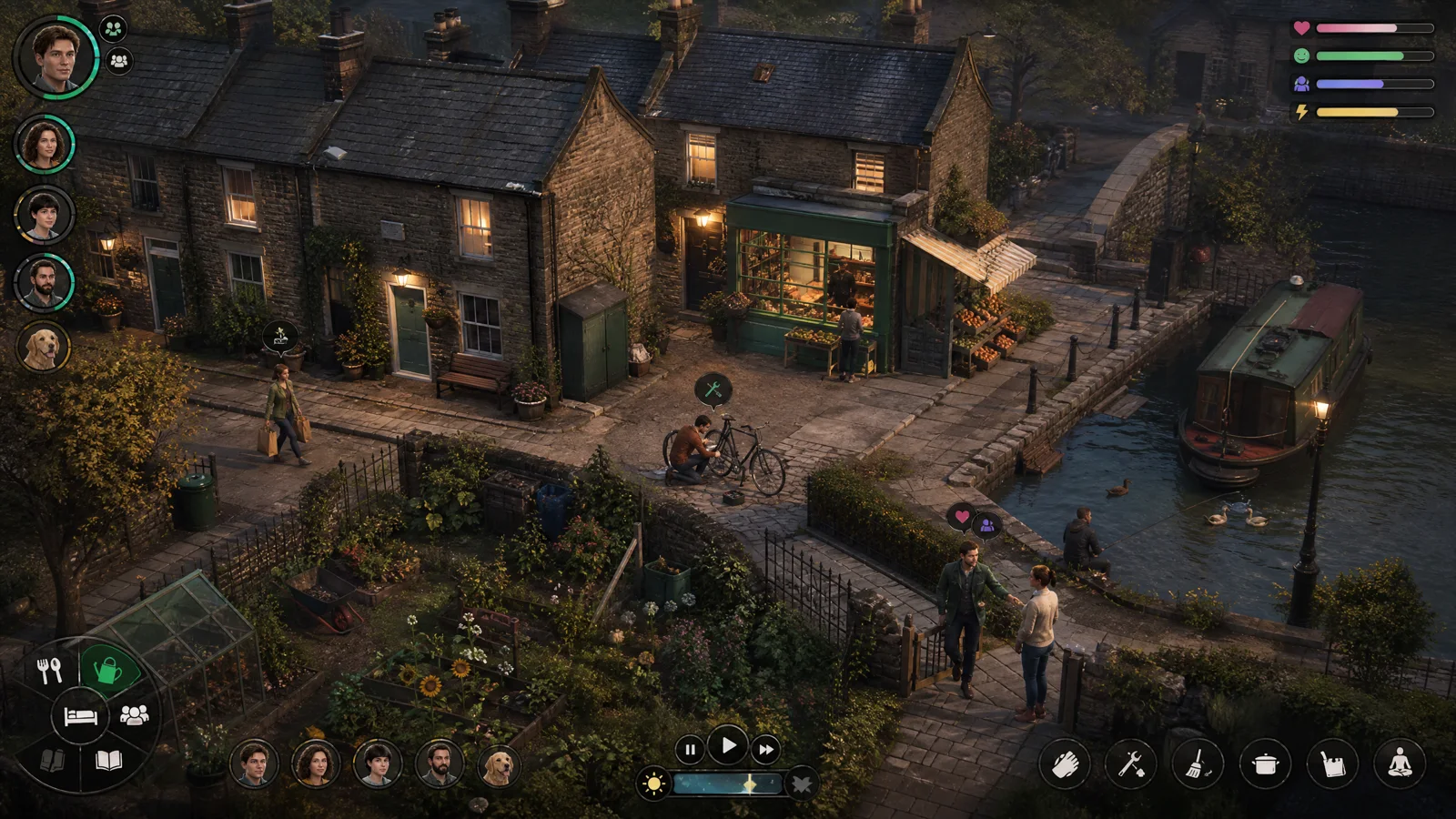
There is a quiet magic in the mundane. While the broader landscape of the medium leans heavily on grand spectacle or apocalyptic stakes, Kingfisher Lane finds its narrative heartbeat in the rhythmic hum of an ordinary neighbourhood. It is an isometric life simulation that trades world-ending cataclysms for the delicate, overlapping routines of terraced housing residents. Here, drama is not forged in the fires of battle, but in the shared spaces, the borrowed cups of sugar, and the unspoken tensions simmering behind every front door.
The Architecture of Routine
From the moment the camera pans over the slate roofs and the gently rippling canal that borders the neighbourhood, it becomes evident that Kingfisher Lane is a masterclass in atmospheric restraint. The game presents an isometric view of a meticulously detailed street of terraced houses, each brick and window box rendered with a warmth that feels instantly familiar. The core mechanic is not about building a sprawling metropolis, but about managing the delicate ecosystem of a single street.
The residents of Kingfisher Lane are individuals bound by their own daily schedules. You watch as Mrs Higgins tends to her marigolds at precisely eight in the morning, while the teenage boy next door drags his feet to the bus stop. The beauty of the simulation lies in how these routines intersect. The game engine tracks the movements, needs, and emotional states of every character, creating a tapestry of overlapping lives. When routines clash—perhaps a noisy late-night gathering disrupts a neighbour's early shift—the game generates emergent narratives that feel entirely organic. It is a system that rewards observation as much as interaction.
This focus on routine extends to the mechanics of household energy. Every action, from cooking a meal to repairing a leaky tap, drains a finite pool of physical and emotional energy. Managing this resource is crucial, as an exhausted resident is far more likely to snap at a neighbour or fail at a community task. The UI elegantly displays these metrics without cluttering the screen, using subtle visual cues—a drooping posture or a heavy sigh—to communicate a character's state.
The Currency of Community
If routine is the foundation of Kingfisher Lane, then relationships are the mortar that holds it together. The game eschews traditional currency in favour of a more nuanced system: the economy of favours. When a resident helps another—whether by taking in a parcel, minding a pet, or assisting with a DIY project—they earn social capital. This capital can then be spent to call in favours of their own. It is a system that perfectly encapsulates the unspoken rules of neighbourhood living, where goodwill is traded as freely as gossip over the garden fence.
The relationship UI is a triumph of design, visualising the complex web of connections between residents. A quick glance reveals who is feuding, who is flirting, and who is simply tolerating one another. These dynamics are not static; they ebb and flow based on your actions and the natural progression of the simulation. A seemingly innocuous decision, such as refusing to lend a lawnmower, can ripple through the community, souring a friendship and leading to a petty rivalry that lasts for weeks.
The game provides several tools for managing these relationships, but it never feels manipulative. You cannot simply buy a neighbour's affection with gifts; you must earn it through consistent, positive interactions. This makes the eventual payoff—a street party where everyone actually gets along—feel incredibly earned.
The Friction of the Everyday
For all its brilliance, Kingfisher Lane is not without its frustrations. The pacing is intentionally slow, mirroring the unhurried rhythm of real life. This will undoubtedly alienate players looking for immediate gratification or high-stakes action. The game demands patience, asking you to invest time in watching a kettle boil or waiting for a neighbour to return from work. While this friction is essential to the game's thematic core, it can occasionally tip over into tedium, particularly during the early hours when the community is still finding its feet.
Furthermore, the UI, while generally elegant, can become unwieldy when managing larger gatherings or complex projects. Selecting the right resident in a crowded scene can be fiddly, and the pathfinding occasionally stumbles when characters are navigating the narrow confines of a terraced house. These are minor blemishes, however, on an otherwise impeccably polished experience. The visual feedback—the way a character's shoulders slump when they are tired, or the warm glow of a living room window on a rainy evening—more than compensates for the occasional mechanical hiccup.
A Quiet Revolution
Kingfisher Lane is a quiet revolution in the life simulation genre. By stripping away the grandiose and focusing entirely on the minutiae of everyday existence, it has created something profoundly moving. It is a game that understands that the most compelling stories are not the ones we are told, but the ones we live alongside others. The overlapping routines, the delicate economy of favours, and the shared triumphs and failures of the community create a rich, emergent narrative that is entirely unique to each playthrough.
In a medium that so often asks us to be heroes, Kingfisher Lane simply asks us to be good neighbours. It is a testament to the power of the mundane, a reminder that there is drama, heartbreak, and joy to be found behind every front door. For those willing to embrace its gentle pace and intricate systems, it offers an experience that is as rewarding as it is deeply human.