
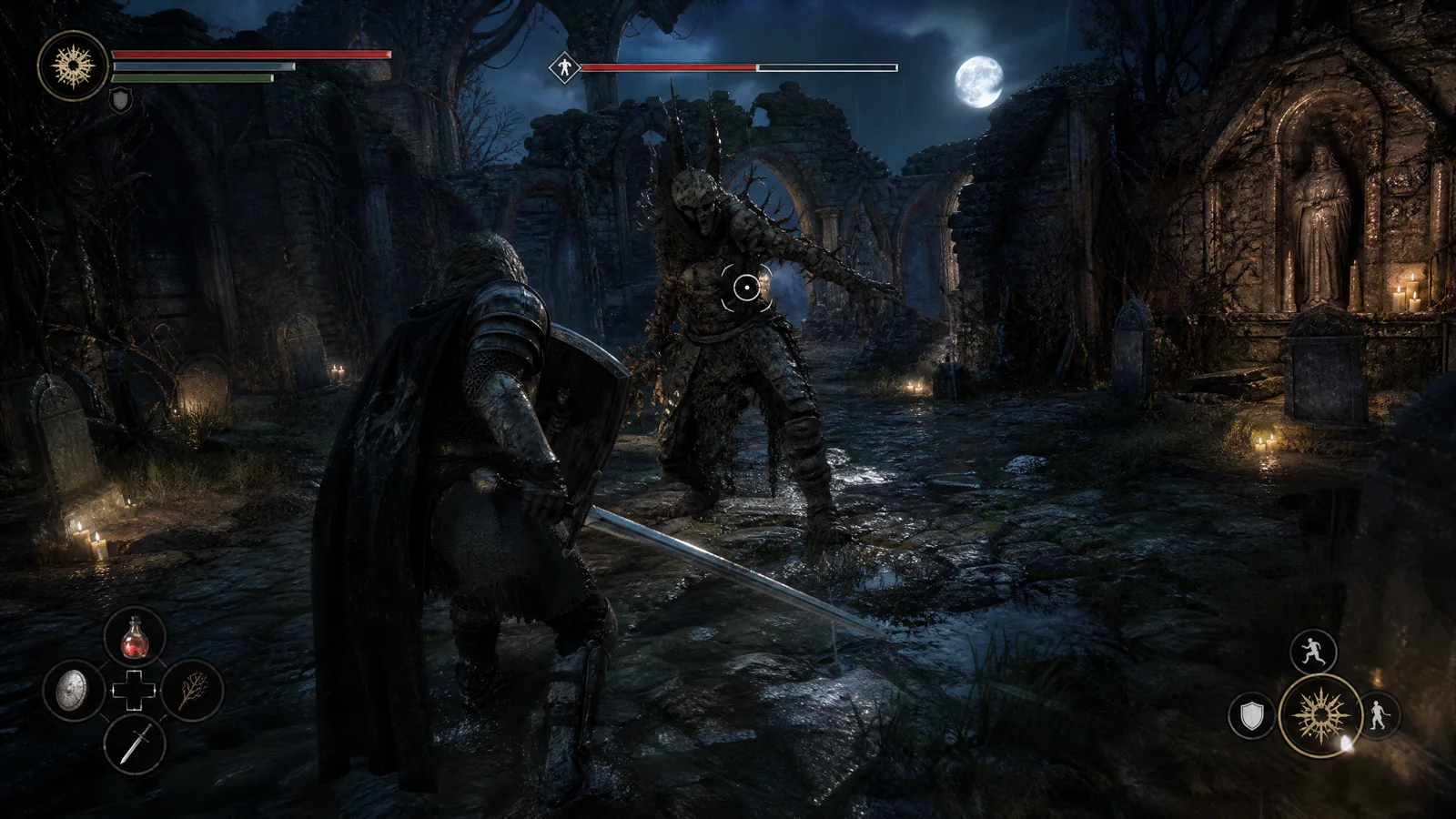
There is a moment in Blackthorn Abbey where the ceaseless rain washing over the ruined cloisters suddenly feels less like a backdrop and more like a warning. Standing before a towering stone guardian, its ancient masonry woven through with pulsing, preternatural thorns, the realisation sets in that every encounter here is a meticulous dance of survival. This gothic action role-playing game does not simply challenge your reflexes; it demands your utmost attention to its environment, its deliberate combat systems, and the creeping flora that threatens to consume everything.
The Cloisters' Embrace
The visual and auditory design of Blackthorn Abbey establishes an atmosphere of oppressive, melancholic beauty from the very first footstep. As our third-person knight navigates the crumbling monastery, the environmental feedback is nothing short of exceptional. The heavy, rhythmic patter of rain against the cobblestones provides a constant, sombre acoustic baseline, punctuated only by the clanking of plate armour and the unsettling, organic creaking of the thorn-covered adversaries. When facing the stone guardian in the cloisters, the visual fidelity is striking. Water streaks down the moss-draped statues, and every swing of a weapon sends dynamic sprays of water and shattered stone across the screen. The lighting engine leans heavily into stark contrasts, using the sparse illumination of dying embers and the cold, grey wash of the storm to highlight the intricate architectural decay. This aesthetic commitment ensures that the abbey is not merely a stage for combat, but a character in its own right, one that constantly communicates its history and its hostility through every cracked archway and flooded courtyard.
Deliberate Steel
Combat in Blackthorn Abbey is a masterclass in deliberate, weighty pacing. The developers have entirely eschewed frantic, button-mashing skirmishes in favour of a system that treats every swing of the sword as a significant commitment. Central to this is the stamina economy, which governs not only your ability to attack and evade but also your capacity to maintain a defence. Exhausting your stamina leaves you in a vulnerable, staggered state, turning what might have been a minor miscalculation into a fatal error. The mechanics of guard direction further complicate these encounters. Players must actively match the angle of incoming attacks, shifting their defensive posture to deflect blows effectively. A successful parry does not simply negate damage; it significantly degrades the enemy's posture, eventually opening them up to brutal, high-damage ripostes.
This posture system applies to both the protagonist and the adversaries, creating a dynamic tug-of-war in every duel. When engaging the stone guardian, for instance, mindlessly striking its hardened exterior yields minimal results and rapidly drains your stamina. Instead, the encounter demands a methodical approach: observing its attack patterns, matching its guard direction, and exploiting the brief windows of vulnerability to chip away at its posture. The physical feedback during these exchanges is phenomenal. Heavy strikes connect with a satisfying, reverberating crunch, whilst deflected blows produce a jarring metallic clang that accurately conveys the sheer force of the impact.
The Creeping Thorns
What truly distinguishes the combat loop from its contemporaries is the innovative thorn growth mechanic. The malevolent flora that infests the abbey is not merely decorative; it is a dynamic hazard that actively alters the battlefield. Enemies like the stone guardian can manipulate these vines, causing them to erupt from the ground to restrict movement or to reinforce their own defences. If left unchecked, the thorns will gradually consume the combat arena, severely limiting your mobility and turning a straightforward duel into a claustrophobic struggle for survival. This mechanic forces players to remain mobile and constantly reassess their spatial positioning.
To counter this creeping threat, the game introduces environmental fire as a crucial tactical tool. Scattered throughout the cloisters are braziers, oil spills, and flammable debris that can be ignited using specific items or abilities. Luring a thorn-armoured adversary into a conflagration not only strips away their organic defences but also temporarily halts the growth of the vines in that area.
- Thorn Expansion: Vines dynamically alter the terrain, restricting movement and demanding constant spatial awareness.
- Environmental Fire: Igniting specific hazards is essential for stripping enemy defences and controlling the battlefield.
- Tactical Positioning: Luring enemies into advantageous areas becomes just as important as mastering the parry system.
Architectural Interconnectivity
The layout of the monastery is a triumph of level design, offering a highly readable, interconnected world that constantly rewards exploration. Blackthorn Abbey eschews a traditional map in favour of organic wayfinding, relying on distinct landmarks, lighting cues, and intuitive environmental design to guide the player. The transition from the flooded crypts to the soaring, rain-lashed rooftops feels seamless, with each distinct zone looping back upon itself in surprising and satisfying ways. Unlocking a heavy oak door to find yourself back at a familiar, safe courtyard is a recurring joy, providing both a physical shortcut and a profound sense of geographical mastery.
Strengths and Limitations
The greatest strength of Blackthorn Abbey lies in the synergy between its systems. The deliberate combat, the dynamic thorn mechanics, and the brilliant level design all feed into one another, creating an experience that is consistently engaging and intellectually demanding. The game respects the player's intelligence, refusing to hold their hand and instead trusting them to learn its intricacies through observation and practice.
However, the experience is not entirely without its flaws. The uncompromising nature of the stamina and guard direction systems can lead to a steep initial learning curve that may frustrate less patient players. Additionally, while the environmental fire mechanic is conceptually brilliant, the hitboxes for igniting oil spills can occasionally feel slightly inconsistent, leading to moments of unearned punishment when a crucial trap fails to trigger in the heat of battle.
Final Judgement
Despite these minor grievances, Blackthorn Abbey stands as a towering achievement in the gothic action role-playing genre. It is a game that demands respect, forcing you to engage with its systems on its own terms. The fusion of methodical, weighty combat with the dynamic, ever-encroaching threat of the thorns creates a unique rhythm that few games manage to achieve. The ruined cloisters, with their ceaseless rain and oppressive atmosphere, offer a setting that is as hostile as it is hauntingly beautiful. For those willing to embrace its punishing difficulty and master its deliberate mechanics, this is an unforgettable journey into a beautifully decaying world.